


Bird of the Day | Daily Avian Digest
The Northern Cardinal: Crimson Royalty, Mirror Feuds, and Backyard Brilliance
By Avery Wren | Content Strategist & Bird Nerd-in-Residence
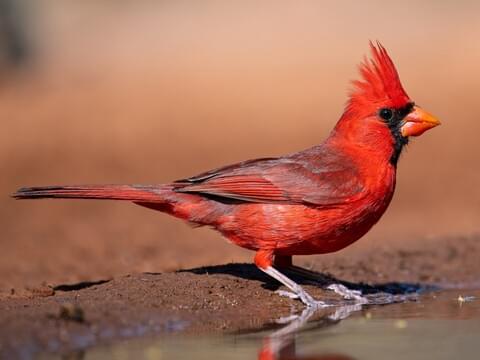
A male Northern Cardinal (Cardinalis cardinalis) perching with full crest display. Photo courtesy of Cornell Lab of Ornithology.
Grab your favorite bird mug, settle into your perch, and let’s talk about the absolute undisputed monarch of the backyard bird feeder: the Northern Cardinal (Cardinalis cardinalis).
If you live anywhere in eastern or central North America, you already know this bird. It is the mascot of seven U.S. states, the poster child for holiday greeting cards, and probably the reason your non-birder roommate knows what a bird feeder is. But don't let their sheer ubiquity fool you into thinking they’re boring. Behind that head-turning crimson plumage lies a songbird packed with attitude, fascinating evolutionary adaptations, and territorial antics that rival a reality TV season finale.
My parakeet Walter gave a high-pitched screech of approval when I pulled up my research notes this morning, so let’s dive right into the science, structure, and snark of this iconic songbird.
Northern Cardinal Fast Facts
- Scientific Name: Cardinalis cardinalis
- Length: 8.3–9.1 in (21–23 cm)
- Wingspan: 9.8–12.2 in (25–31 cm)
- Diet: Granivore/Insectivore (Seeds, berries, insects, fruit)
- Conservation Status: Least Concern (Population stable and expanding)
- Favorite Feeder Snack: Black oil sunflower seeds
How to Accurately Identify a Northern Cardinal
Identifying a male Northern Cardinal seems like a no-brainer—he looks like a flying stop sign with a mohawk. However, proper field identification requires looking past the flashy paint job, especially when sorting out females, juveniles, or distant silhouettes.
1. The Male: Unapologetic Crimson
Adult males are nearly entirely saturated in brilliant red plumage. The key features to lock in on are the distinct, spiky head crest (which raises or lowers depending on their mood) and a dark, black facial mask that extends around the base of the beak and down the throat. Their bills are heavy, conical, and bright orange-red—perfectly engineered for cracking open stubborn seed husks.
2. The Female: Subdued Elegance
Female cardinals are often criminally overlooked, but quietly boast one of the sleekest color palettes in the avian world. They are primarily a soft fawn-brown or olive-tan, accented with subtle crimson washes on their crest, wing edges, and tail feathers. Like the males, females sport a striking orange-red bill and a soft, dark gray mask around the eyes and beak.
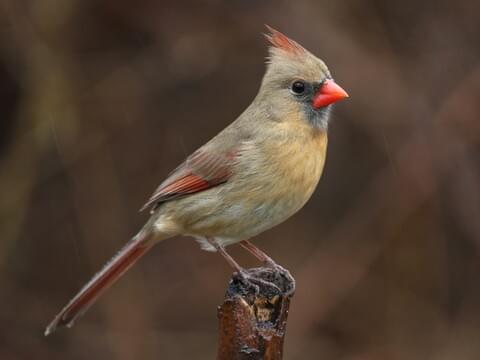
Female Northern Cardinal demonstrating the subtle crest and warm fawn coloration.
3. Silhouette and Behavior Cues
Even in poor lighting where color vanishes, you can identify cardinals by shape and movement:
- The Profile: A long, full tail paired with a heavy-chested posture and a tall, triangular crest.
- The Flight Style: They fly with low, undulating swoops, rarely traveling long distances above the treetop canopy.
- Voice: Listen for a sharp, metallic "chip!" call note that sounds like two marbles clicking together, or their famous whistling song often transcribed as "cheer, cheer, cheer" or * "birdie, birdie, birdie!"*
Habitat: Where Songbirds and Suburbia Meet
Where do Northern Cardinals hang out? The short answer: almost everywhere humans have cleared a bit of space and planted shrubbery. According to telemetry and distribution data from the National Audubon Society, their range covers the entire eastern half of the United States, extending south through Mexico and Central America, and stretching west into portions of Arizona and Texas.
Cardinals are edge-habitat specialists. They thrive in places where open spaces meet dense cover. Naturally, this includes forest edges, overgrown fields, thickets, swamps, and riverbanks. Unnaturally—but very conveniently for birdwatchers—it also includes suburban backyards, parks, overgrown garden beds, and cemetery hedge rows.
They avoid deep, unbroken wilderness interiors and treeless plains. If you give them dense, thorny brush (like honeysuckle, dogwood, or blackberry tangles) to nest in and an open yard to forage for seeds, cardinals will happily set up a permanent residence. Unlike many songbirds, Northern Cardinals are non-migratory year-round residents. The same pair visiting your feeder in July will likely be shivering in your pine trees come January.
Field Notes: The Best Way to Spot a Cardinal in the Wild
Finding a Northern Cardinal isn't like tracking an elusive Boreal Owl; you don't need a five-mile backcountry hike at midnight. However, if you want guaranteed views, keep these field strategies in mind:
- Catch the Early Shift (or Twilight): Cardinals are crepuscular feeders. They are almost always the very first birds to arrive at feeders in the dim morning light and the last ones to leave as night falls. If sunrise is at 6:00 AM, have your binoculars ready at 5:45 AM.
- Set the Ultimate Feeder Trap: Want cardinals in your yard? Skip the cheap millet mixtures. Fill a sturdy hopper or platform feeder with black oil sunflower seeds or safflower seeds. Position the feeder within 10–15 feet of low, thick shrubbery so they feel safe darting back and forth from cover.
- Listen for the "Chip" in Thick Brush: Cardinals spend a lot of time foraging low to the ground or inside thick foliage where their bright colors are hidden. If you hear a loud, sharp "chip!" coming from a dense bush, freeze. They are letting their mate know their location—or scolding you for standing too close to their favorite feeding patch.
Avian Quirks: Mirror Feuds and Dueting Partners
Now for my favorite part of the post: the weird, wonderful behavioral quirks that make cardinals absolute gems to study.
The Springtime Mirror Battle
Have you ever seen a male cardinal repeatedly flying into a car side-mirror or glass window pane in late March? No, he hasn't lost his mind—he's defending his turf. During the breeding season, male cardinals experience a surge in testosterone that makes them fiercely territorial. When they catch their reflection in a reflective surface, they don't see a reflection; they see a bold intruder trying to take over their territory. They will fight this "ghost bird" for hours on end. (Pro-tip: If this is happening to your car, cover the mirror with a plastic bag for a couple of days!).
Female Songstress
In most North American songbird species, only the males sing complex tunes. The Northern Cardinal is a delightful exception. Female cardinals regularly sing from the nest, often while sitting directly on eggs. Ornithologists at the Cornell Lab of Ornithology suggest that female songs may communicate to the male when to bring food back to the nest—essentially an avian food delivery order.
Comments
Post a Comment